> For the complete documentation index, see [llms.txt](https://city-protocol.gitbook.io/docs/llms.txt). Markdown versions of documentation pages are available by appending `.md` to page URLs; this page is available as [Markdown](https://city-protocol.gitbook.io/docs/platform/product-mechanics/issuance-and-operation-layer.md).

# Issuance & Operation Layer

The product layer that launches and runs Curated Vault products and OTPs through one seven-stage lifecycle.

The Issuance & Operation Layer is City Protocol's product layer for launching and running tokenized financial products onchain. A structured product carries concrete operating requirements: what it can hold, how its holdings are weighted, when they change, who can subscribe or exit, which fees apply, which disclosures are shown and what happens when a component becomes stale, paused, impaired or ineligible. An issuer that launches such a product alone rebuilds the same machinery each time, and the layer standardizes it. Zenith has audited the layer together with Vault as a Service and Tokenization as a Service.

## Product logic as infrastructure

The governing principle is product logic as infrastructure. Issuers define the mandate or methodology, and the layer supplies the issuance and operating machinery that makes it verifiable, governable and distributable. Lower manufacturing cost brings more issuers, and more issuers widen the range of products a participant can reach from one wallet.

| The issuer defines                                                                                                                                              | The layer supplies                                                                                                                                                             |
| --------------------------------------------------------------------------------------------------------------------------------------------------------------- | ------------------------------------------------------------------------------------------------------------------------------------------------------------------------------ |
| For a Curated Vault product, the mandate: target exposure, component universe, liquidity terms, risk limits, fee structure, NAV cadence and distribution policy | The product registry, component validation, issuance, product-level NAV, the primary market, rebalancing inside the mandate, eligibility, disclosure and lifecycle management  |
| For an OTP, the methodology: the constituents, the weights at purchase and the third-party public source or published rule that can change the list             | The portfolio registry, constituent validation, methodology enforcement, composition reporting, published list changes, eligibility, exit, disclosure and lifecycle management |

Curators and issuers define the mandates and methodologies of the products. Each OTP methodology is published as a rules-based, non-personalized rule set before the product opens.

## Relation to TaaS and VaaS

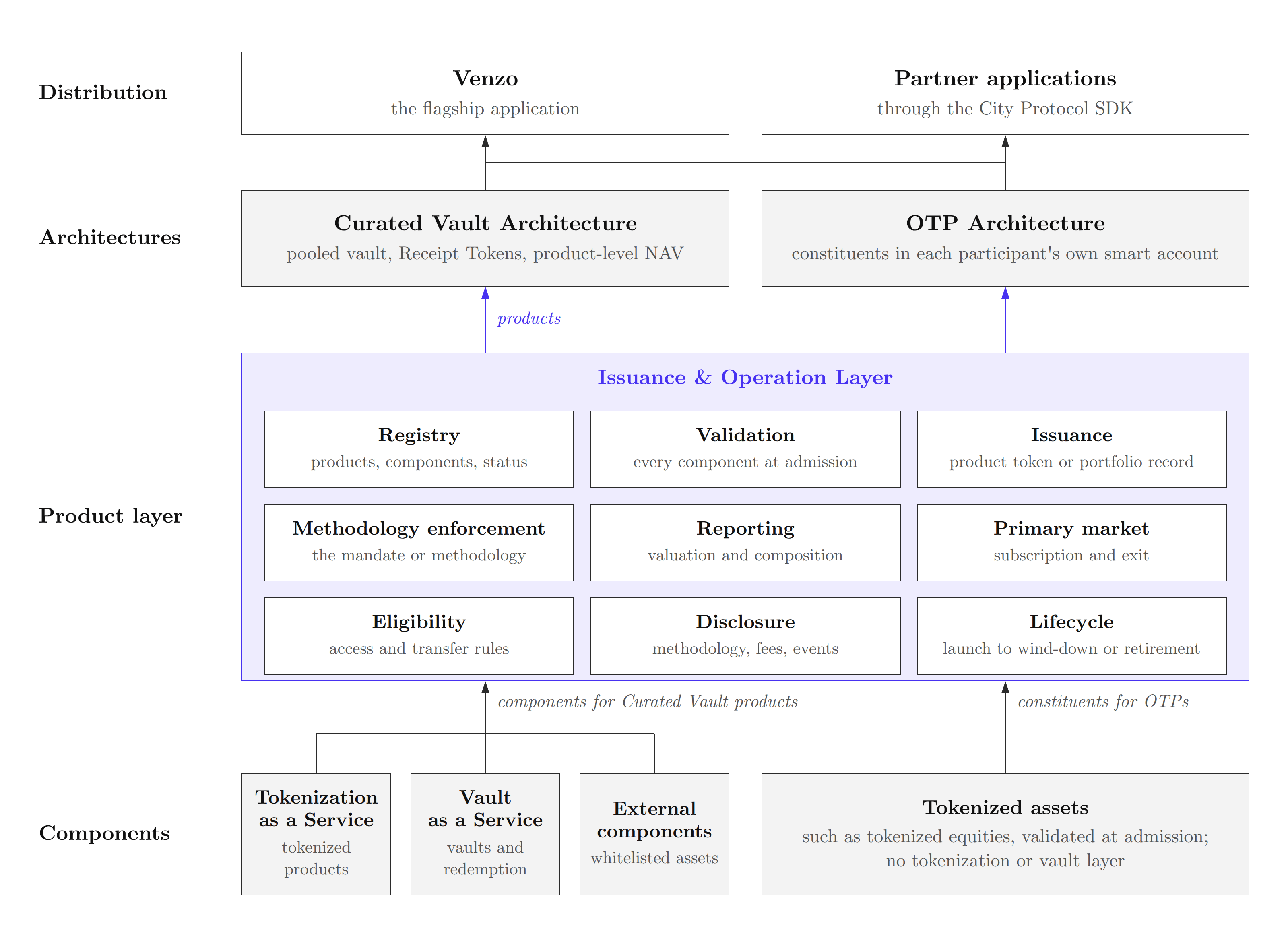
TaaS creates the tokenized yield product: its token representation, investor eligibility, NAV monitoring and attestations. VaaS operates the vault and the capital controls behind it: the vault contracts, the report oracle, epoch settlement and bounded strategy execution. The Issuance & Operation Layer sits above both as the framework for product issuance, product-level accounting, methodology enforcement, rebalancing, reporting and ongoing operations, and Venzo and partner applications distribute the products it issues. TaaS and VaaS supply Curated Vault products only. An OTP draws on neither. Its constituents are tokenized assets, such as tokenized equities, validated at admission and held in each participant's own smart account.

<figure><img src="https://3297077862-files.gitbook.io/~/files/v0/b/gitbook-x-prod.appspot.com/o/spaces%2FJxNp2waFk6hg1G4lEQZu%2Fuploads%2FhjUdiG4FdjW1iaxIf5fB%2Ffig-iol-position.png?alt=media" alt="Tokenization as a Service, Vault as a Service and whitelisted external components feed Curated Vault products, and tokenized assets such as tokenized equities feed OTPs, through the Issuance and Operation Layer, whose nine functions are registry, validation, issuance, methodology enforcement, reporting, primary market, eligibility, disclosure and lifecycle; the products reach Venzo and partner applications"><figcaption><p>Where the layer sits. Curated Vault products draw on TaaS, VaaS and whitelisted external components, OTPs hold tokenized assets such as tokenized equities, and the layer supplies nine functions to both.</p></figcaption></figure>

## What the layer supplies

### For Curated Vault products

The Curated Vault Architecture composes TaaS products, VaaS vaults and whitelisted external components into products with one methodology, one product-level NAV and one subscription and redemption path.

* **Product registry:** The canonical record of live products, with product IDs, component lists, methodology versions, fees, capacity, eligibility policy and lifecycle status.
* **Component validation:** Every proposed component passes eligibility checks for its type before it enters a product, and component whitelisting keeps each product inside its approved universe.
* **Issuance:** The issuance engine creates the product token, share, receipt or position record and links it to the registry entry, the eligibility logic, the NAV source and the redemption path.
* **Product-level NAV:** The unified NAV module aggregates verified component values, idle assets, liabilities and accrued fees into one product NAV, which becomes official only after a signer quorum authorizes it and it passes the freshness and deviation checks.
* **Primary market:** The primary market module runs subscription, creation, redemption, epoch closure, price locks, liquidity checks and claim execution.
* **Rebalancing inside the mandate:** The rebalancing controller executes allocation changes only within the approved bands, component whitelists, venue rules and governance limits.
* **Disclosure and lifecycle:** The disclosure layer publishes the methodology, exposure, NAV history, fees and product events, and the lifecycle manager runs launch, component changes, methodology and fee updates, pauses, migrations, maturity and wind-down.

The ten modules behind these functions, the participants and the controls are set out in [Curated Vault product layer](/docs/platform/product-mechanics/issuance-and-operation-layer/curated-vault-product-layer.md).

### For OTPs

The OTP Architecture hosts the OTPs that City Protocol issues. It keeps every constituent in each participant's own smart account and enforces the published methodology around it.

* **Portfolio registry:** Records live portfolios, constituent lists, methodology versions, fee schedules, eligibility policies and lifecycle status.
* **Constituent validation:** Each constituent's token address, backing, price source, onchain liquidity and transfer restrictions are checked at admission, and a constituent that fails cannot enter a portfolio.
* **Methodology enforcement:** One transaction buys the constituents at the weights the methodology sets. After purchase the weights follow the market: nothing is sold because a name grew, and nothing is bought because a name lagged.
* **Composition reporting:** The position is the set of token balances in the participant's own account, readable onchain at any time.
* **List changes on the named source or rule:** The list changes only on the third-party public source or the published rule that the methodology names, and each change is published on the product page before it executes and recorded on the portfolio's Rebalances tab. As of September 2026, the Index OTPs hold fixed lists.
* **Exit:** One transaction converts the basket back to one asset, or the participant sells any constituent on its own, at any time and including while a product is paused.

The account factory, the eligibility policy, the exit router, the permission validators and the next-phase Rebalancing Executor and Basket Execution Router are set out in [OTP modules and participants](/docs/platform/product-mechanics/how-otps-work/otp-modules-and-participants.md), and the infrastructure behind them in [Technical overview](/docs/platform/product-mechanics/how-otps-work/technical-overview.md).

## The seven-stage lifecycle

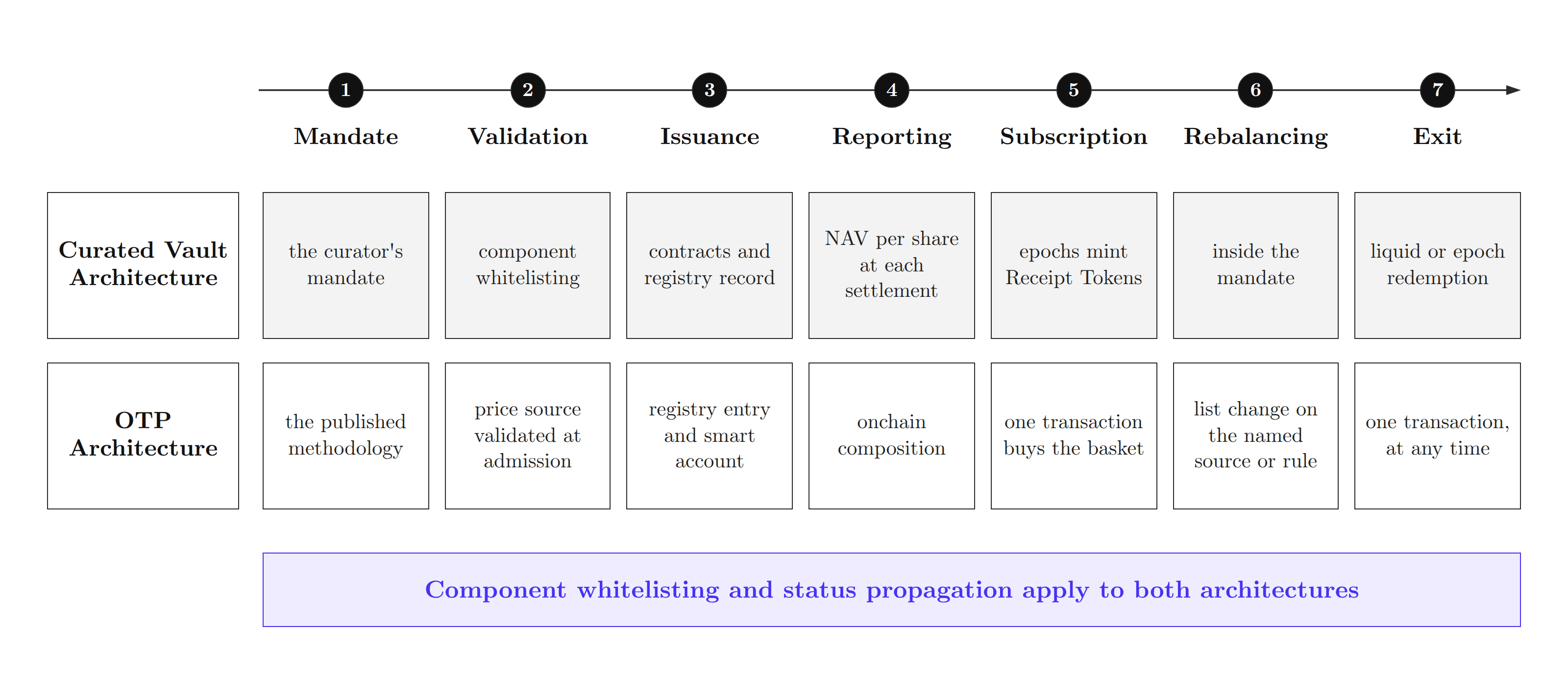
Both architectures move through the same seven stages: mandate, validation, issuance, reporting, subscription, rebalancing and exit. What each stage does depends on the architecture.

<figure><img src="https://3297077862-files.gitbook.io/~/files/v0/b/gitbook-x-prod.appspot.com/o/spaces%2FJxNp2waFk6hg1G4lEQZu%2Fuploads%2FQTaoyx2hgZNepBQUvwEV%2Ffig-iol-lifecycle.png?alt=media" alt="Seven numbered stages, mandate, validation, issuance, reporting, subscription, rebalancing and exit, with what each stage means for the Curated Vault Architecture and for the OTP Architecture; component whitelisting and status propagation apply to both"><figcaption><p>One lifecycle for both architectures. Curated Vault products report NAV per share. OTPs report their onchain composition.</p></figcaption></figure>

{% stepper %}
{% step %}

### Mandate

**Curated Vault products:** The issuer or curator defines the target exposure, the component universe, the product type, the target audience, the liquidity terms, the risk limits, the fee structure, the NAV cadence and the distribution policy.

**OTPs:** City Protocol publishes the methodology: the constituents, the weights at purchase, the third-party public source or published rule that can change the list, the accepted subscription assets, the fee schedule, the eligibility policy and the distribution policy. The methodology is published and versioned before the product opens, so a participant can establish what the portfolio holds, and when its list changes, before subscribing.
{% endstep %}

{% step %}

### Validation

**Curated Vault products:** Each proposed component is checked for eligibility against the criteria for its type, and component whitelisting restricts the product to components that pass.

**OTPs:** Each proposed constituent is checked for its token address and network, its issuer and backing model, custody or reserve verification, its price source, its onchain liquidity and its transfer restrictions. The price source is validated at admission, and a constituent that fails validation cannot enter the portfolio.
{% endstep %}

{% step %}

### Issuance

**Curated Vault products:** The product is issued and configured to its approved methodology. A vault is deployed as its own set of contracts, with its own access policy, limits, oracle and registry record.

**OTPs:** The portfolio is recorded in the portfolio registry with its methodology version, fee schedule and eligibility policy. At a participant's first purchase, the account factory deploys a smart account owned by the participant's wallet, and no asset moves before that purchase.
{% endstep %}

{% step %}

### Reporting

**Curated Vault products:** The layer calculates product-level NAV from component values and product accounting state, and a Curated Vault reports NAV per share at each settlement.

**OTPs:** The layer reports onchain composition: the constituents held and the balance of each, in each participant's own account.
{% endstep %}

{% step %}

### Subscription

**Curated Vault products:** The primary market module checks the accepted asset, participant eligibility, product status, capacity, deposit limits, current NAV and fee rules. Deposits mint Receipt Tokens at the epoch's settlement price, or at once in a synchronous-deposit vault, and an asynchronous request stays pending until the next pricing or settlement cycle.

**OTPs:** The eligibility policy is checked, and one transaction buys every constituent at the methodology's weights and delivers it into the participant's smart account. Subscription settles within that transaction.
{% endstep %}

{% step %}

### Rebalancing or list change

**Curated Vault products:** Rebalancing runs only inside the approved mandate. The rebalancing controller checks allocation bands, component eligibility, liquidity, venue rules, execution permissions and pause state, and each rebalance is indexed into the product's reporting history.

**OTPs:** The list changes only on the named source or rule, and each change is published on the product page before it executes and recorded on the Rebalances tab. As of September 2026, the Index OTPs hold fixed lists. In the next phase, the Rebalancing Executor will apply each published change inside every enrolled account, and the Basket Execution Router will settle the legs as one atomic batch.
{% endstep %}

{% step %}

### Exit

**Curated Vault products:** Participants redeem under the product's liquidity terms, through liquid redemption from idle liquidity or epoch-based redemption against funded claims. A wind-down strikes a final NAV, liquidates components, verifies the settlement assets and opens claims.

**OTPs:** The participant exits at any time from their own account, in one transaction or one constituent at a time, including while a product is paused. When an OTP is retired, subscriptions and published list changes stop, notice is published first and every asset stays with its participants.
{% endstep %}
{% endstepper %}

## Component whitelisting and status propagation

Component whitelisting restricts every product to approved components: TaaS products, verified VaaS vaults and whitelisted external components for Curated Vault products, and validated tokenized assets for OTPs. Each component type has its own validation checks.

| Component          | Checked at validation                                                                                                                                                                                 |
| ------------------ | ----------------------------------------------------------------------------------------------------------------------------------------------------------------------------------------------------- |
| TaaS product       | Product status, token address, NAV source, verification records, transfer policy, supported networks and redemption terms                                                                             |
| VaaS vault         | Vault status, strategy whitelist, latest NAV, capacity, redemption queue, pause state, proof records and risk controls                                                                                |
| External component | Whitelist approval, price source, custody or reserve verification, liquidity profile and allowed venue policy                                                                                         |
| OTP constituent    | Token address and network, issuer and backing model, custody or reserve verification and proof of backing, price source, onchain liquidity profile, approved trading venues and transfer restrictions |

Status propagation carries a component's state to every product that holds it. When a component is paused, impaired, stale, expired or ineligible, the registry updates each product's status automatically. A Curated Vault product pauses the subscriptions, redemptions or rebalancing that depend on the component. An OTP pauses new subscriptions and published list changes, and participant exit stays open. The action that each state triggers in a Curated Vault product is set out in [Curated Vault product layer](/docs/platform/product-mechanics/issuance-and-operation-layer/curated-vault-product-layer.md#security-and-risk-controls), and the propagation across the stack in [Product mechanics](/docs/platform/product-mechanics.md#how-state-propagates-between-layers).

## Example product templates

Issuers start from example product templates. Vault-style templates are Curated Vault products, so they carry target weights and product-level NAV.

OTP-style templates follow the OTP rules: the methodology sets the weights at purchase, and the list changes only on a named source or rule.

| Template                             | Architecture  | Description                                                                                                         | Key configuration fields                                                                                                                                           |
| ------------------------------------ | ------------- | ------------------------------------------------------------------------------------------------------------------- | ------------------------------------------------------------------------------------------------------------------------------------------------------------------ |
| RWA income basket                    | Curated Vault | Tracks a basket of approved RWA or tokenized yield components under one product wrapper                             | Component universe, inclusion criteria, target weights, NAV source, creation and redemption rules, fee schedule, eligibility policy, disclosure template           |
| Multi-vault income product           | Curated Vault | Allocates across several verified VaaS vaults under one product wrapper                                             | Eligible vault list, target weights, allocation bands, aggregate liquidity terms, NAV cadence, capacity, fee layering policy, redemption window                    |
| Stable-yield blend                   | Curated Vault | Combines tokenized treasury, private credit, cash-management or conservative DeFi components into one yield product | Component universe, minimum liquidity buffer, collateral or reserve requirements, yield source disclosure, NAV cadence, eligibility policy, risk label             |
| Thematic allocation product          | OTP           | Holds a defined theme through a rules-based basket of approved tokenized assets                                     | Methodology, inclusion rule, weights at purchase, the published rule that changes the list, concentration limits, disclosure template                              |
| Market-neutral strategy product      | Curated Vault | Packages a manager or rules-based strategy with approved venues and drawdown controls                               | Approved assets and venues, leverage limit, drawdown threshold, rebalance triggers, performance fee, high-water mark, reporting cadence                            |
| Copy-allocation product              | Curated Vault | Lets participants follow a vetted manager or signal provider inside a controlled product mandate                    | Approved manager, approved venues, trade or rebalance rules, maximum exposure, drawdown limit, fee terms, reporting cadence, redemption period                     |
| Tenor-based structured yield product | Curated Vault | Provides exposure for a defined term with scheduled settlement or maturity                                          | Tenor, base component, payoff logic, early redemption policy, settlement schedule, NAV method, maturity process, risk disclosure                                   |
| Model portfolio for partners         | OTP           | Lets wallets, exchanges, fintech apps or wealth products embed predefined allocations through the City Protocol SDK | Partner distribution policy, eligible participant rules, constituents and weights at purchase, list-change rule, product card metadata, subscription and exit flow |

The thematic template follows the Thematic OTP type, which will arrive with the next phase. The templates are starting points, and final product availability depends on the asset type, the jurisdiction, the legal structure, the liquidity terms, partner approval and risk disclosure.

## Selecting an architecture

The determining question is what the participant is acquiring.

<figure><img src="https://3297077862-files.gitbook.io/~/files/v0/b/gitbook-x-prod.appspot.com/o/spaces%2FJxNp2waFk6hg1G4lEQZu%2Fuploads%2FKlxMf6ougwhSZIRqwsQs%2Ffig-iol-select.png?alt=media" alt="The question of what the participant is acquiring leads through five product needs: a managed return, an exposure that needs pooling or a transferable claim token lead to the Curated Vault Architecture; a defined basket to hold, or direct ownership and per-asset control, lead to the OTP Architecture"><figcaption><p>Selecting an architecture. A return that an operator must produce leads to a pooled Curated Vault. A basket held as the exposure itself leads to an OTP.</p></figcaption></figure>

| What the participant acquires                                                                                                    | Architecture  |
| -------------------------------------------------------------------------------------------------------------------------------- | ------------- |
| A managed return that an operator must produce, such as market-neutral trading, credit underwriting, lending or structured yield | Curated Vault |
| A defined basket of assets to hold, bought at the weights a published methodology sets                                           | OTP           |
| An exposure that needs pooling to work, such as capacity-limited strategies or shared counterparty positions                     | Curated Vault |
| An exposure where direct ownership, per-asset control and structural transparency are required                                   | OTP           |
| A product that needs a transferable claim token for use elsewhere onchain                                                        | Curated Vault |

Both architectures are non-custodial, both enforce a published rule set, and both publish their methodology and operating history. They differ in whether capital is pooled to produce a return or held as the exposure itself.