> For the complete documentation index, see [llms.txt](https://city-protocol.gitbook.io/docs/llms.txt). Markdown versions of documentation pages are available by appending `.md` to page URLs; this page is available as [Markdown](https://city-protocol.gitbook.io/docs/platform/product-mechanics/tokenization-and-verification/tokenization-lifecycle.md).

# Tokenization lifecycle

The seven stages that take a tokenized product from onboarding to redemption or wind-down, and the operations and participants that run it in between.

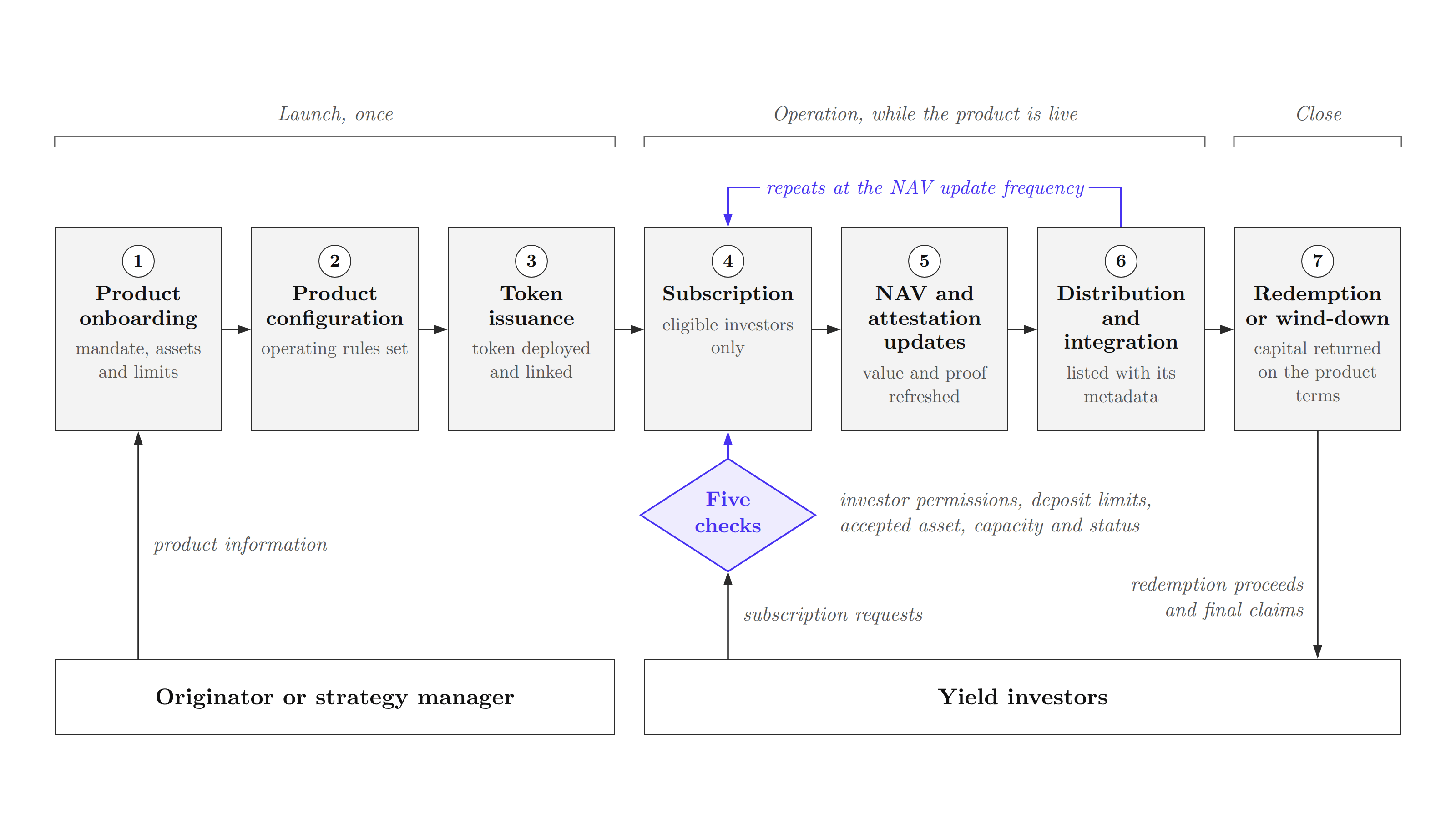
Every tokenized product follows the same seven-stage lifecycle. The first three stages launch the product once; subscription, NAV and attestation updates, and distribution then run for as long as the product is live; and the last stage returns capital to investors on the product's terms.

<figure><img src="https://3297077862-files.gitbook.io/~/files/v0/b/gitbook-x-prod.appspot.com/o/spaces%2FJxNp2waFk6hg1G4lEQZu%2Fuploads%2FBCQIsX9CArf5R0b8D7Us%2Ffig-taas-lifecycle.png?alt=media" alt="Seven stages from product onboarding to redemption or wind-down, grouped as launch, operation and close, with an update loop over subscription, updates and distribution, and a five-check gate on every subscription request from yield investors"><figcaption><p>The tokenization lifecycle. Every subscription passes five checks, and subscription, updates and distribution repeat at the NAV update frequency while the product is live.</p></figcaption></figure>

{% stepper %}
{% step %}

### Product onboarding

The asset originator or strategy manager submits the product information:

* strategy mandate;
* target assets;
* expected liquidity profile;
* risk limits;
* service providers;
* legal structure;
* supported networks;
* required investor eligibility.

**RWA-backed products:** Onboarding also covers the borrower profile, the collateral type, the collateralization ratio, the custodian or administrator information, the reserve account structure and the verification partner setup.

**Trading strategies:** Onboarding also covers the approved exchanges, the approved assets, leverage limits, market exposure limits, drawdown limits, settlement frequency and reporting cadence.
{% endstep %}

{% step %}

### Product configuration

City Protocol configures the product according to its operating rules, across thirteen fields:

* accepted subscription assets;
* minimum deposit;
* maximum capacity;
* management fees;
* performance fees;
* redemption window;
* NAV update frequency;
* oracle quorum;
* eligible investor type;
* transferability;
* supported chains;
* distribution channels;
* emergency controls.

Each curator sets its vault's fees within the hard caps of the fee manager, as set out in [Fees](/docs/platform/product-mechanics/fees.md).
{% endstep %}

{% step %}

### Token issuance

The token contract or tokenized share representation is deployed, and the deployment connects the token to six components:

* its product registry entry;
* its oracle source;
* its permissioning module;
* its subscription flow;
* its redemption flow;
* its reporting interface.

Where applicable, the token follows existing token and vault standards for compatibility with external integrations: a Curated Vault share follows ERC-4626 share accounting with ERC-7540 asynchronous requests and ERC-7575 share discovery.
{% endstep %}

{% step %}

### Subscription

Eligible investors subscribe through Venzo, partner applications or an API integration. Before any capital moves, the subscription flow checks five conditions:

* investor permissions;
* deposit limits;
* accepted asset type;
* product capacity;
* product status.

Once the subscription is approved, the investor receives the token, a receipt or a vault share, depending on the product design. On Curated Vault rails, the participant receives Receipt Tokens when the deposit epoch settles, or at once in a vault that takes synchronous deposits.
{% endstep %}

{% step %}

### NAV and attestation updates

The NAV monitoring oracle and the attestation engine update the product state at the configured NAV update frequency. Each update answers four questions:

1. What is the current product value?
2. What inputs were used to calculate it?
3. Who verified the inputs?
4. Are subscriptions and redemptions safe to process at this value?

An update that fails its checks pauses subscriptions, redemptions or both until the issue is resolved, as set out in [Oracle, attestations and API](/docs/platform/product-mechanics/tokenization-and-verification/oracle-attestations-and-api.md).
{% endstep %}

{% step %}

### Distribution and integration

The product is exposed through Venzo, partner applications and eligible DeFi integrations. Its distribution metadata carries ten items:

* asset type;
* strategy type;
* expected liquidity;
* supported networks;
* verification status;
* risk controls;
* fees;
* capacity;
* historical NAV;
* redemption rules.
  {% endstep %}

{% step %}

### Redemption or wind-down

Investors redeem according to the product terms. A liquid product supports immediate or near-immediate redemption, and a less liquid product redeems through epochs, scheduled windows or settlement periods. When a product closes or migrates, TaaS provides the operational path for the final NAV, claim processing and reporting. The Curated Vault redemption paths and wind-down are set out in [Deposits, capital flow and redemption](/docs/platform/product-mechanics/how-curated-vaults-work/deposits-capital-flow-and-redemption.md).
{% endstep %}
{% endstepper %}

## Ongoing operations

Between launch and wind-down, the lifecycle management module runs twelve operations.

| Phase                | Operations                                                                                                                                        |
| -------------------- | ------------------------------------------------------------------------------------------------------------------------------------------------- |
| Launch               | Product creation and configuration; issuer and strategy onboarding; token issuance                                                                |
| Operation            | Subscription windows; NAV updates; investor permission updates; attestation publication; liquidity provisioning; redemption processing; reporting |
| Exceptions and close | Emergency pauses; product wind-down or migration                                                                                                  |

These operations separate TaaS from a plain token deployment and give City Protocol and its partners one operating system for every tokenized yield product.

## Participants at each stage

Six participants operate a tokenized product. The asset originator and the strategy manager supply the asset, the strategy and its updates; third-party verifiers confirm the inputs and claims behind each value; the TaaS layer issues the token and runs its controls; integration partners bring the product to investors in their applications; and yield investors subscribe, hold and redeem.

<figure><img src="https://3297077862-files.gitbook.io/~/files/v0/b/gitbook-x-prod.appspot.com/o/spaces%2FJxNp2waFk6hg1G4lEQZu%2Fuploads%2FHpw1vFeahe2DNj2UWjec%2Ffig-taas-participants.png?alt=media" alt="The asset originator and the strategy manager send data into the City Protocol TaaS layer, a third-party verifier sends verified inputs and claims, the layer exchanges product data and requests with an integration partner, the investor subscribes and redeems through the partner, and tokens go to the yield investor"><figcaption><p>The six participants and what passes between them. Investors reach the product through a partner application, and the token, receipt or vault share is issued to the investor.</p></figcaption></figure>

| Stage                        | Who acts                                                                                                                                                                        |
| ---------------------------- | ------------------------------------------------------------------------------------------------------------------------------------------------------------------------------- |
| Product onboarding           | The asset originator or strategy manager submits the product information                                                                                                        |
| Product configuration        | City Protocol configures the product according to its operating rules                                                                                                           |
| Token issuance               | The TaaS layer deploys the token and connects it to its registry entry, oracle source, permissioning, subscription, redemption and reporting                                    |
| Subscription                 | Yield investors subscribe through Venzo, a partner application or an API integration, and the TaaS layer runs the five checks                                                   |
| NAV and attestation updates  | The strategy manager supplies performance reports and operational updates, third-party verifiers verify the inputs, and the TaaS layer publishes the value and the attestations |
| Distribution and integration | Integration partners list the product with its distribution metadata                                                                                                            |
| Redemption or wind-down      | Yield investors redeem, and the TaaS layer processes the claims, the final NAV and the reporting                                                                                |

Each participant's role is defined in [Tokenization architecture](/docs/platform/product-mechanics/tokenization-and-verification/tokenization-architecture.md).
